

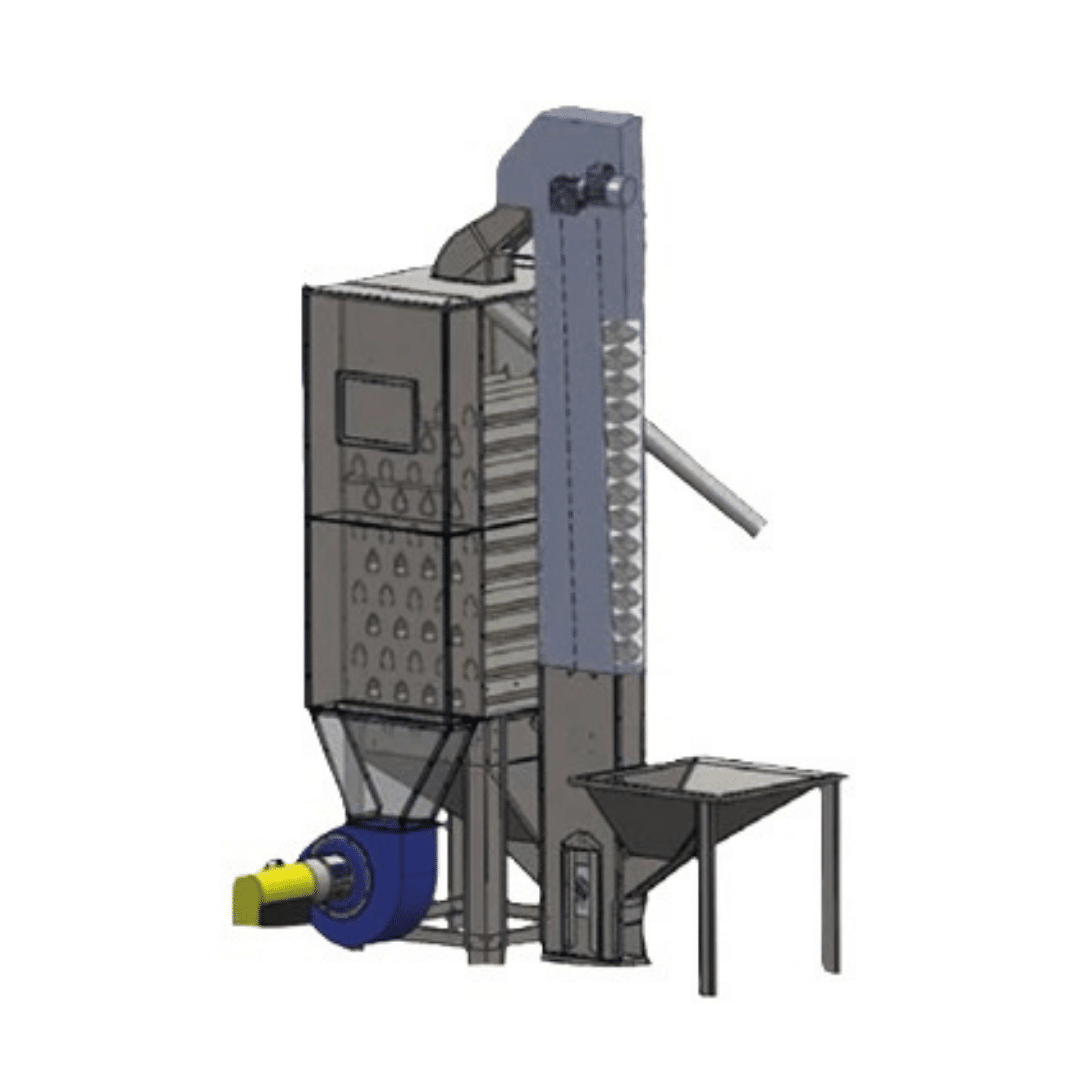
Recirculating Batch Grain Dryer for Seeds, Cereals and Pulses
The ADDAMS recirculating batch grain dryer is designed for controlled moisture reduction in seeds, cereals, pulses and oilseeds. Instead of passing through the drying section only once, the product is repeatedly circulated through the tower. Each pass exposes the material to conditioned air, followed by mixing and tempering before the next cycle.
This multi-pass process supports crops with varying moisture levels or temperature limits. Every project is sized around the crop, moisture duty and site conditions.
Why Use a Recirculating Batch Dryer?
A recirculating dryer can suit plants that process separate lots, multiple crop varieties or valuable seed requiring careful control. Because the product is mixed during circulation, moisture and temperature differences within the batch can be reduced over successive passes. Operators can sample the material and continue drying until the required condition is reached.
The system is also useful where harvest moisture changes during the season. A fixed batch can be processed according to its actual condition instead of being forced through one standard continuous-flow setting. Drying time and fuel use will vary with crop, weather and moisture-removal duty.
Typical Products and Applications
Suitable applications may include wheat, maize, barley, paddy rice, soybean, sunflower, canola, lentils, chickpeas, peas and selected seed crops. The dryer can serve farms, seed plants, cooperatives, storage facilities, grain processors and export preparation lines.
Crop behavior affects selection. Paddy may require careful tempering, high-moisture maize creates a larger evaporation load, and planting seed generally requires lower product temperatures. Oilseeds and pulses have their own flow and heat-sensitivity characteristics.
How the Recirculating Drying Cycle Works
- Loading: Product is transferred into the dryer tower through an elevator or suitable conveyor. Level indication helps confirm the correct batch volume.
- Drying pass: The grain descends through the drying section while heated air moves through the product column and carries moisture to the exhaust.
- Discharge and recirculation: A controlled outlet meters the product into the recirculation conveyor or bucket elevator, which returns it to the top.
- Mixing and tempering: Recirculation mixes the batch. Rest periods can allow internal moisture to migrate toward the kernel surface before the next drying pass.
- Cooling and unloading: When the target is reached, the system can switch to cooling where configured, then discharge the product to storage or further processing.
The exact sequence is adjusted to the crop and process objective. Drying should not be controlled by air temperature alone; product temperature, exhaust condition, measured moisture and visual inspection all contribute to operating decisions.
Main Components and Configuration
| Component | Function and project considerations |
|---|---|
| Holding and drying tower | Contains the batch and directs the product through the drying zone. Capacity and geometry are project-specific. |
| Air-heating system | Raises process-air temperature using an approved fuel or indirect heat source selected for the site. |
| Drying fan | Provides the airflow and pressure required to move air through the crop bed. |
| Metering discharge | Controls product flow from the tower and supports a stable recirculation rate. |
| Recirculation equipment | Returns material to the top of the tower using an elevator and connected conveying equipment. |
| Exhaust system | Releases moisture-laden air and can be coordinated with dust-management equipment. |
| Control and sensors | Monitor temperature, fan and burner status, level, motor condition and other selected process signals. |
Construction, access, weather protection, dimensions and structural loads are defined for the installation.
Capacity and Drying-Time Calculation
Batch capacity should be stated for a defined crop and bulk density. The same tower volume holds different mass quantities of wheat, maize, sunflower or light seed. Usable capacity can also change with safe fill level and the space required for product movement.
Drying time depends on the amount of water to be removed, heat input, airflow, ambient temperature and humidity, crop condition and permissible drying temperature. For example, reducing a wet batch by a large number of moisture points requires more time and energy than final conditioning near the storage target. ADDAMS calculates the proposed duty from the customer’s product data rather than publishing one universal cycle time.
Seed-Friendly Temperature Control
Seed viability can be damaged by excessive kernel temperature even when the air temperature appears acceptable. A seed-drying project should therefore define the maximum allowable product temperature and consider germination requirements, variety and initial condition. Lower-temperature operation may extend the drying cycle but helps reduce thermal stress.
Recirculation improves mixing, but it does not guarantee identical moisture in every kernel. Sampling from representative points remains important. When germination or breakage targets are critical, laboratory checks and a controlled commissioning program are recommended.
Tempering and Moisture Equalization
During drying, moisture near the grain surface is removed more quickly than moisture at the center. Tempering provides time for internal moisture to migrate outward before the next heated-air exposure. This can support more gradual drying and reduce steep moisture gradients.
Heat Source and Fuel Options
The heating system may be configured for natural gas, LPG, diesel, biomass or an indirect heat exchanger, subject to local availability and project requirements. Direct-fired and indirect systems have different implications for efficiency, emissions and contact between combustion products and drying air.
Fuel selection should consider operating cost, cleanliness, service availability, temperature stability and applicable food or seed standards. Burner capacity and fan duty are matched to the calculated evaporation load. All combustion equipment requires suitable ventilation, safety controls and commissioning by qualified personnel.
Automation, Monitoring and Operating Control
A control panel can coordinate loading, fan operation, heating, recirculation, cooling and discharge. Selected systems may include product and air-temperature sensors, level switches, motor-current monitoring, flame supervision and alarm history. Online moisture measurement can support the operator, but periodic verification with an appropriate calibrated method is still advisable.
Interlocks should prevent heating without confirmed airflow and stop fuel supply when a critical fault occurs.
Airflow, Exhaust and Dust Management
Uniform airflow through the crop column is essential. Restrictions, product build-up or uneven filling can create inconsistent drying. Intake air, fan selection, plenum geometry and exhaust openings are therefore engineered as a connected system.
Dryers can release dust and light particles with humid exhaust air. Local emission requirements and combustible-dust risks must be assessed for the specific crop and site. Ducts, cyclones, filters, grounding, fire detection or explosion-protection measures may be required as part of the wider installation.
Installation and Plant Integration
The complete system may include an intake hopper, pre-cleaner, elevators, conveyors, buffer bins and finished-product storage. Removing foreign material before drying can improve flow and reduce the accumulation of combustible residues. Inlet and outlet elevations should be coordinated with the plant layout.
Foundations and supports must account for filled weight, operating loads, wind and local requirements. Safe inspection access and suitable outdoor electrical protection are also required.
Cleaning and Preventive Maintenance
Routine checks should cover the tower interior, discharge mechanism, elevator, belts or chains, bearings, fan, burner, filters, sensors and safety devices. Residues should be removed before they restrict airflow or create a hygiene, pest or fire risk.
Before service, operators must isolate power, fuel and moving equipment. Maintenance intervals depend on crop, duty and dust loading.
Frequently Asked Questions
What is the difference between batch and continuous grain drying?
A batch dryer holds one lot and repeatedly circulates it until the target is reached. A continuous dryer receives and discharges product while operating. The better choice depends on throughput, crop variation and operating strategy.
Can the dryer be used for planting seed?
Yes, when product temperature, airflow and cycle settings are selected for the seed and verified during commissioning. Germination requirements should be stated before design.
How long does one drying batch take?
Cycle time depends on crop, moisture reduction, heat input, airflow and weather. It is calculated for the stated project conditions.
Can different crops be dried in the same machine?
Many dryers can process several suitable crops, but capacity and settings must be adjusted for density, flow behavior, heat sensitivity and moisture load.
Can the product be cooled before discharge?
Cooling can be included in the operating sequence where the configuration and ambient conditions allow it.
What information is required for a quotation?
Please provide crop types, batch mass, bulk density, initial and target moisture, maximum product temperature, ambient conditions, available fuels, electrical supply, operating hours and site layout.
Request a Recirculating Batch Dryer Proposal
Share your crop data, moisture targets and required batch capacity with ADDAMS. Our team can develop a project-specific dryer arrangement covering tower volume, airflow, heat source, recirculation equipment, controls and plant connections.
Related Equipment and Process Options
Coordinate the drying cycle with loading, product transfer, cooling and buffer storage.
- Fluid Bed Dryer for Seeds & Grain
- Fluid Bed Air Cooler
- Grain Bucket Elevator for Seeds & Cereals
- Screw Conveyor
- Square Silos
Share your product sample, target capacity, quality requirements and existing line layout. Request your custom quote from ADDAMS to evaluate equipment selection and process connections.
Reviews
There are no reviews yet.