

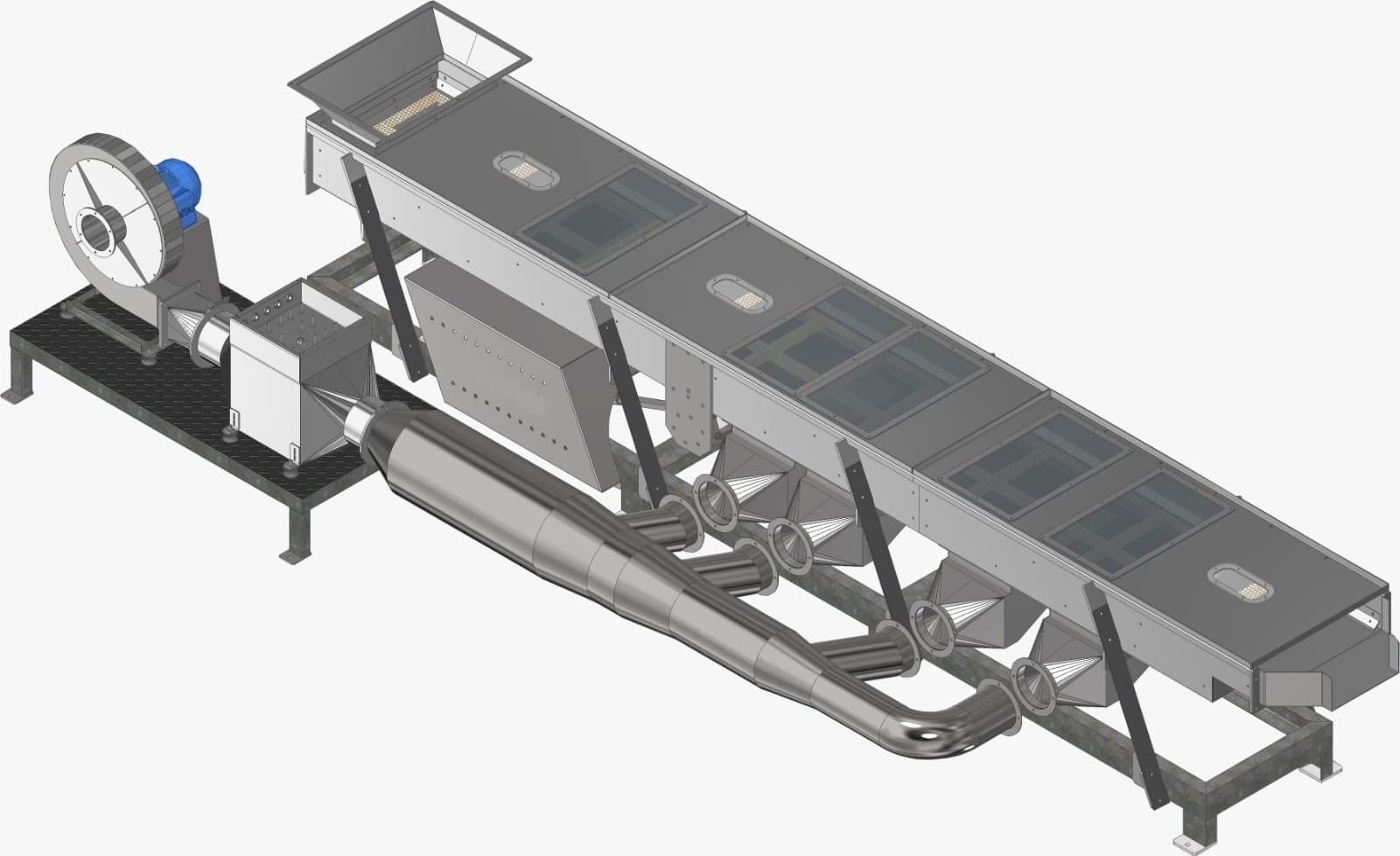
Fluid Bed Dryer for Seeds, Grain and Granular Products
The ADDAMS fluid bed dryer is designed for controlled drying, cooling and moisture stabilization of seeds, grains, pulses and other suitable granular products. Air passes through a perforated bed to loosen the product layer, improving heat and moisture transfer as material moves through the machine.
Fluid bed performance depends on particle size, density, moisture targets, allowable temperature, throughput and residence time. ADDAMS configures each system around representative product data.
Typical Applications
The dryer may be integrated after seed treatment, washing, cooking, steam processing, roasting or another operation that leaves a product warm or moist. Typical applications include treated seed, cereals, pulses, oilseeds, selected herbs, pellets and other free-flowing granular materials. It can also serve as a product cooler when ambient or conditioned air is required before storage or packaging.
Not every material fluidizes in the same way. Very light particles may be carried into the exhaust, while sticky, irregular or wide-size-range products can form channels or move unevenly. Application review and, where necessary, product testing help determine whether a static or vibratory fluid bed is appropriate.
How Fluid Bed Drying Works
Process air is supplied to a plenum below the perforated bed. The distribution plate spreads the airflow across the working area. When the air velocity is correctly matched to the material, it lifts and separates the particles enough to create a mobile, fluid-like layer. The exposed particle surfaces exchange heat and moisture with the air stream.
The product enters at the feed end and moves through one or more process zones. Heated air may be used for moisture removal, followed by ambient or cooled air for final temperature reduction. At the outlet, the product should meet the agreed moisture and temperature range before transfer to the next machine, storage bin or packaging system.
Main Components and Configuration Options
| Component | Function and selection considerations |
|---|---|
| Feed section | Distributes incoming material across the bed. A regulated feed rate helps maintain an even product depth and residence time. |
| Perforated bed | Supports the product and distributes air. Hole pattern and open area are selected for the material and airflow requirement. |
| Air plenum | Balances air below the bed and can be divided into separate process zones. |
| Fans | Provide the airflow and pressure needed for fluidization, drying or cooling. Variable-speed control may be included. |
| Heating system | May use a steam coil, hot-water coil, gas-fired system or another approved heat source according to the project. |
| Exhaust and dust collection | Removes moisture-laden air and manages entrained fines through suitable ducts, cyclones or filters. |
| Controls and sensors | Monitor operating parameters such as inlet-air temperature, outlet-air temperature, product temperature, pressure and fan status. |
Food-contact surfaces can be selected in stainless steel where hygiene or corrosion resistance requires it. Insulation, access doors, viewing points, removable sections and cleaning provisions are defined according to product and plant standards.
Static and Vibratory Fluid Bed Options
A static bed relies primarily on airflow and bed geometry to fluidize and transport the material. It can suit products with predictable flow behavior and a relatively consistent particle size. A vibratory fluid bed adds controlled mechanical movement to help advance material, regulate residence time and reduce the risk of stagnant zones.
The design should balance fluidization, conveyance, product protection, cleaning and energy use.
Drying and Cooling Zones
A modular fluid bed can be divided into several independently controlled zones. Early zones may use warmer air for moisture removal, while later zones can use lower-temperature or ambient air to equalize and cool the product. Zone length, airflow and temperature are adjusted to the required residence profile.
For heat-sensitive seed, product temperature is normally more important than air temperature alone. The control strategy should prevent overheating and respond to changes in feed moisture or flow. When a project requires a specific number or size of zones, those dimensions are confirmed during engineering rather than treated as universal specifications.
Capacity and Process Sizing
Dryer capacity cannot be selected reliably from tonnes per hour alone. Engineering calculations also require initial moisture, target moisture, product temperature, ambient conditions, bulk density and evaporation load. A small moisture reduction at high throughput can require a different air system from a large reduction at lower throughput.
Residence time, bed depth and airflow must be coordinated. A bed that is too deep may fluidize unevenly, while excessive air velocity can carry light particles into the exhaust. ADDAMS uses the project data to define working area, zone arrangement, fan duty, heat input and exhaust volume. Final performance figures are stated in the technical proposal for the specified product and conditions.
Heating Sources and Air Preparation
The air-heating system can be matched to the utilities available at the site. Steam or hot-water coils provide indirect heating where a boiler system is already installed. Other projects may use an indirect gas heater or an approved electric arrangement. Heat-source selection should consider temperature control, product safety, energy availability and maintenance.
Air filtration and the effects of local temperature and humidity are included in project sizing.
Uniformity and Product Protection
Suitable feeders, spreaders and level control help maintain an even bed and consistent airflow.
Fluidization can reduce some forms of mechanical handling because particles are partly supported by air, but it does not eliminate contact or breakage risk. Fragile, coated or valuable seed should be evaluated for acceptable impact, vibration and attrition. Representative trials are advisable when strict germination, coating-loss or breakage limits apply.
Exhaust Air, Fines and Dust Control
Drying releases humid air and may entrain dust or light particles. Exhaust design is therefore part of the process, not an optional afterthought. Duct sizing, air balance and separation equipment must match the fan duty and product. Cyclones, bag filters or other collection equipment may be selected depending on particle loading and emission requirements.
Combustible dust requires a site-specific risk assessment. Grounding, electrical classification, isolation and explosion protection must be defined by qualified specialists for the actual product, installation and applicable regulations. The final safety concept should include connected ducts, filters and downstream equipment.
Controls and Line Integration
The dryer can be coordinated with upstream feeding and downstream conveying so that changes in line flow do not overload the bed. Temperature, pressure and fan feedback can be displayed through a control panel or integrated into the plant automation system. Alarms and interlocks can stop feeding when airflow, temperature or discharge conditions fall outside the permitted range.
Early coordination of the process flow, utilities, available space and connection elevations helps prevent unsuitable duct routes or restricted maintenance access.
Cleaning and Maintenance
Routine inspection should include the perforated bed, air plenum, seals, fans, bearings, heaters, filters, sensors and discharge mechanism. Blocked perforations or accumulated fines can change airflow distribution and reduce process consistency. Access points should be included where operators need to inspect or clean product-contact areas.
Cleaning procedures depend on the crop, treatment chemical, allergen policy and hygiene standard. Before maintenance, the machine and connected utilities must be safely isolated. Operators should follow the project manual and site safety procedures.
Frequently Asked Questions
Which products are suitable for a fluid bed dryer?
Many free-flowing seeds, grains, pulses, pellets and granular products can be considered. Suitability depends on particle size, density, stickiness, fragility and the required moisture reduction.
Can the same machine dry and cool the product?
Yes. A multi-zone arrangement can use heated air for drying and ambient or conditioned air in later zones for cooling, subject to process calculations.
How is the required dryer capacity calculated?
Sizing uses throughput together with initial and target moisture, evaporation load, product temperature, bulk density, ambient conditions and residence time.
Is a vibratory fluid bed always necessary?
No. Static and vibratory designs suit different materials. Product behavior and the required movement through the bed determine the better arrangement.
Can steam be used to heat the drying air?
Yes. A steam-to-air heat exchanger can be selected when suitable steam is available. Pressure, temperature and coil duty are confirmed for the project.
What information is needed for a quotation?
Please provide the product, hourly capacity, initial and target moisture, inlet and required outlet temperature, bulk density, available utilities, operating hours, site conditions and hygiene requirements.
Request a Project-Specific Fluid Bed Dryer Proposal
Share your product data, moisture target and plant layout with ADDAMS. Our team can evaluate the drying load and propose a fluid bed configuration, heating system, airflow arrangement and control concept matched to your process.
Related Equipment and Process Options
Evaluate drying with feed consistency, subsequent cooling and exhaust-air management.
Share your product sample, target capacity, quality requirements and existing line layout. Request your custom quote from ADDAMS to evaluate equipment selection and process connections.
Reviews
There are no reviews yet.