

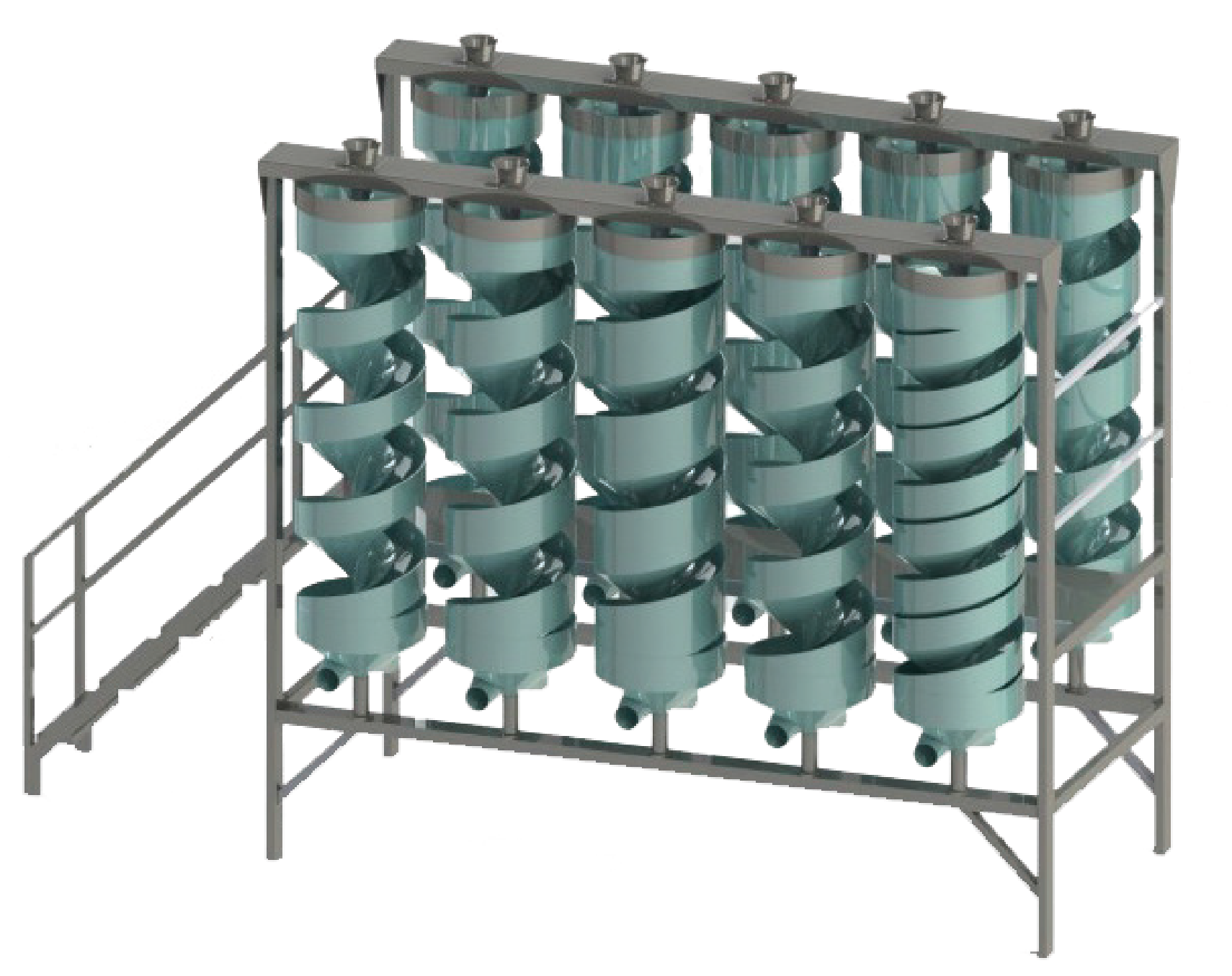
Seed Spiral Separator: Precision Gravity-Based Round-Seed Classification
The ADDAMS Seed Spiral Separator separates suitable free-flowing materials by differences in shape and rolling behaviour. Round seeds follow a different path from flatter, split or irregular particles as they move down the spiral under gravity. It can be considered for seed conditioning duties where these differences provide a useful separation.
Applications can include separating splits from round soybeans and evaluating shape-based cleaning for suitable clover, mustard or canola lots. Performance depends on the actual mixture, surface condition and feed consistency. Discuss a representative sample and your required product quality with ADDAMS before confirming the configuration.
Spiral Separator Components and Selection Factors
The following items should be reviewed for your application. Capacity, dimensions, construction materials and module arrangement must be confirmed in the project specification.
| Component | Purpose and selection factors |
|---|---|
| Feed inlet and distributor | Supplies material to the spiral paths. Review feed uniformity, product flow and upstream connection. |
| Spiral flights | Provide the separation path. Select the arrangement around particle shape, surface characteristics and the required throughput. |
| Product outlets | Collect the separated fractions. Confirm the outlet arrangement and connections to downstream equipment. |
| Housing and access | Supports containment, inspection and cleaning. Confirm access space and construction requirements. |
| Feeding and discharge equipment | Integrates the separator into the plant. Review elevations, flow control and the destination of each fraction. |
Operating Principle: Centrifugal Gravity Separation
Precision Flow Technology and Work Principle
The Spiral Separator operates solely on the laws of physics. Product quality must be assessed for the material and operating conditions, particularly when handling high-value sowing seed.
-
Intake and Distribution: Seed is loaded into the hopper or direct feed tube. The material flows over a manually adjustable deflector cone, which divides the material evenly across the inner flights of the spiral.
-
Kinetic Stratification: As the seeds move down the spiral, they gain speed. Because of their shape, rounder seeds roll faster and gain higher centrifugal force.
-
Flight Separation: The round material rolls off the inner flights onto the larger outer flights. Less mobile particles may remain on the inner flights. The separation depends on a sufficient difference in rolling behaviour between the fractions.
-
Discharge: The round seeds exit through a common prime product side discharge chute at the bottom, while the non-round material exits through a separate discharge chute.
Practical Advantages and Operating Considerations
- Gravity-driven separation: The separation principle needs no electric drive; feeders, elevators and dust-control equipment may still require power.
- Simple operation: Stable feeding and outlet settings support repeatable separation.
- Product-focused selection: Assess the mixture and quality requirements before choosing the configuration.
- Inspection and cleaning: Plan access and routines for checking surfaces, outlets and residual material.
How Shape-Based Spiral Separation Works
The spiral separator classifies free-flowing material according to the way each particle rolls and moves under gravity. Round, smooth seeds accelerate toward the outside edge of the spiral, while flatter, irregular or less mobile particles remain closer to the inner section. Separate discharge points collect the resulting fractions. The separation principle does not require an electric drive. Feeding, discharge and auxiliary equipment should be reviewed as part of the complete installation.
Where a Spiral Separator Fits in the Cleaning Line
A spiral separator can follow air-screen cleaning and density separation when the remaining mixture differs in rolling behaviour. The screen cleaner first removes material that differs in size, while the gravity separator removes products with a different specific weight. The spiral then handles shape differences that cannot be separated reliably by screens or airflow alone. It can also be installed before final optical sorting to reduce the colour sorter’s reject load and manage the material sent to the next stage.
Common Applications
- Removing flat, split or misshapen seeds from round seed lots
- Separating round weed seeds from crop seed where shape behaviour differs
- Cleaning peas, soybeans, vetch, rapeseed, mustard and selected vegetable seeds
- Recovering usable product from mixed fractions after grading
- Classifying metal shot, glass beads, ceramic media and other free-flowing industrial particles
Selecting the Correct Spiral Configuration
Separation performance depends on particle shape, surface texture, moisture, feed consistency and capacity. The number of spiral flights, internal diameter, inclination and feed distribution must match the product. A uniform, controlled feed is particularly important: overloading the inlet reduces the space available for particles to establish different paths and can lower separation accuracy.
ADDAMS can evaluate a representative sample and recommend the appropriate configuration, number of units and upstream equipment. For larger capacities, multiple spiral modules can operate in parallel. Collection chutes and outlets can be arranged for clean product, intermediate product and rejects, allowing the intermediate fraction to be recirculated when greater recovery is required.
Installation and Operating Advantages
- No electric motor required for the separation principle
- Handling suitability assessed for fragile and high-value planting seed
- Small footprint and simple integration into gravity-fed layouts
- Low maintenance requirements and easy visual inspection
- Adjustable product outlets for practical commissioning and fine-tuning
For reliable results, the feed should be cleaned of large foreign material and supplied at a stable rate. Our engineering team can integrate the Seed Spiral Separator with elevators, feeders, screen cleaners, gravity separators, optical sorters and packing systems as part of a complete processing line.
Seed Spiral Separator Frequently Asked Questions
Which materials can be separated?
Suitable free-flowing mixtures with different rolling behaviour can be assessed. Round crop seed and flat or split particles are common examples. Similar-looking particles may behave alike, so sample evaluation is more useful than assuming suitability from the crop name alone.
Does the separator require electricity?
The gravity-driven separation principle needs no motor. The surrounding line may use powered feeders, elevators or dust-control equipment. Assess the energy requirements of the complete installation when comparing conveying and separation arrangements.
What affects separation performance?
Shape, surface texture, moisture, feed rate and the proportion of unwanted particles all matter. A stable feed gives the particles room to establish different paths. Define the required purity and acceptable product loss before evaluating results.
What capacity should I specify?
State the crop, mixture and target throughput. Capacity must be confirmed for the chosen arrangement and material; a figure for one crop cannot automatically be applied to another. Include peak demand and planned product changes in your enquiry.
Is it maintenance-free?
No. Even a separator without a powered separation mechanism needs inspection and cleaning. Check surfaces, outlets and feed distribution, and manage residual product between batches. Follow the maintenance requirements supplied with the equipment.
What do you need for a quotation?
Send the material, target throughput, impurity description, quality criteria and available layout. A representative sample can help assess the separation. Include inlet and outlet elevations and the equipment feeding and receiving each fraction.
Checking Separation Results
During commissioning, collect samples from each outlet and compare them with the agreed product quality criteria. Assess both the clean fraction and the amount of usable seed entering the reject stream. Record the feed condition and settings so later production checks have a clear reference. If the incoming mixture changes, repeat the assessment before assuming the previous settings still provide the required separation. This review helps balance product recovery with the desired purity.
Discuss Your Seed Separation Duty
Explore the ADDAMS grain and seed processing machine range for the surrounding cleaning line. Contact ADDAMS with your material details and layout to discuss a Spiral Separator configuration matched to the application.
Reviews
There are no reviews yet.